In Chapter 9 of Writing for Digital Media, Brian Carroll addresses the decay of institutional authority and the collapse of traditional journalistic “objectivity.” In its place, he highlights NYU professor Jay Rosen’s concept that transparency has become the new objectivity in digital spaces. Rather than claiming a detachment or complete neutrality—which audiences increasingly distrust or view as posturing—digital communicators establish credibility through radical openness: disclosing their perspectives, laying bare their methodologies, citing primary source materials, and inviting public scrutiny into how conclusions are drawn.
This shift from institutional authority to methodological transparency is evident in how investigative reporting and public-interest commentary operate on modern platforms. A prime example is the work of Bellingcat, an independent international collective of researchers and citizen journalists. When analyzing high-stakes global events—such as tracing military movements or debunking state-sponsored propaganda—Bellingcat does not ask readers to simply trust their reputation or brand. Instead, they publish open-source intelligence (OSINT) guides, raw satellite imagery, geolocation coordinates, and step-by-step verification processes directly alongside their reports.

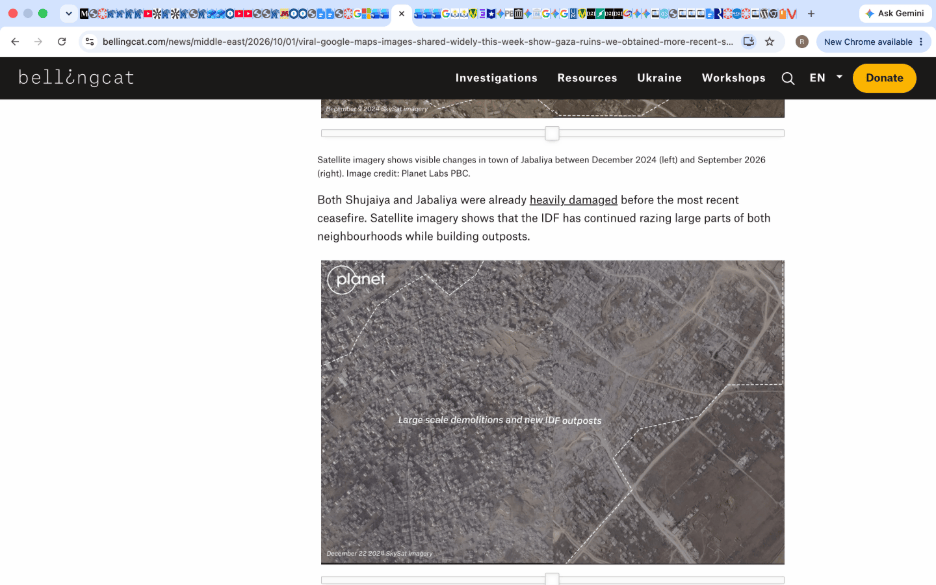
A screenshot of an open-source intelligence analysis showing side-by-side satellite images and map coordinates used to verify the location of a video recording.
In an environment where generative AI tools can produce hyper-realistic deepfakes and hallucinated evidence in seconds, asserting truth through top-down authority no longer works. As Carroll notes, generative AI chatbots are often “frequently wrong but never in doubt,” making believable falsehoods cheaper and faster to spread than ever before. Platforms like TikTok and X (formerly Twitter) amplify content optimized for engagement rather than accuracy, driving users into insulated echo chambers. When information can be easily manipulated or synthetically generated, credibility relies not on who delivers the message, but on whether the audience can independently trace and audit the process of its creation.
While traditional objectivity relied on the illusion of distance to build authority, digital credibility requires visibility of process. To slow down the spread of misleading information, responsible digital writers, educators, and organizations must transition from acting as passive gatekeepers to acting as transparent curators. By embedding hyperlinked chains of evidence, acknowledging implicit biases, and explicitly documenting verification steps, digital communicators shift the audience’s role from passive consumption to active evaluation. Transparency demystifies truth-seeking, transforming verification into an open, inspectable practice that algorithmically generated disinformation cannot easily replicate.
How Key Stakeholders Can Slow Misleading Information
- Digital Writers: Practice process-tracing by linking directly to raw datasets, primary documents, and unedited video footage rather than summarizing second-hand claims. Disclose potential conflicts of interest or analytical angles upfront.
- Educators: Teach lateral reading and digital auditing techniques (such as cross-referencing OSINT or checking original file metadata) rather than relying solely on checklist-style evaluation frameworks.
- Organizations & News Outlets: Adopt explicit, easily accessible corrections policies and publish behind-the-scenes methodology notes—similar to the open-source auditing practiced by investigative networks or the standards outlined in NPR’s Accountability Guidelines.
- Audiences: Pause before sharing, inspect embedded source links, and evaluate whether a post offers verifiable methodology or merely leverages emotional identification.
Takeaway & Public Question If transparency is indeed the primary firewall against AI-driven disinformation, we must ask ourselves: As generative AI becomes more adept at mimicking transparent reporting formats—fabricating citations, synthetic metadata, and fake audit trails—how can audiences differentiate between genuine methodological openness and artificially generated authenticity?


Leave a Reply